



Clause details checked against Advisera's clause-by-clause comparison and certification-body notices on 22 October 2026.
It's the 30th, 6:40 in the evening. Two lots are still waiting for final inspection, and the truck has been at the gate since five. The plant head is on the phone.
Under ISO 9001:2026, an auditor can ask what you did next.
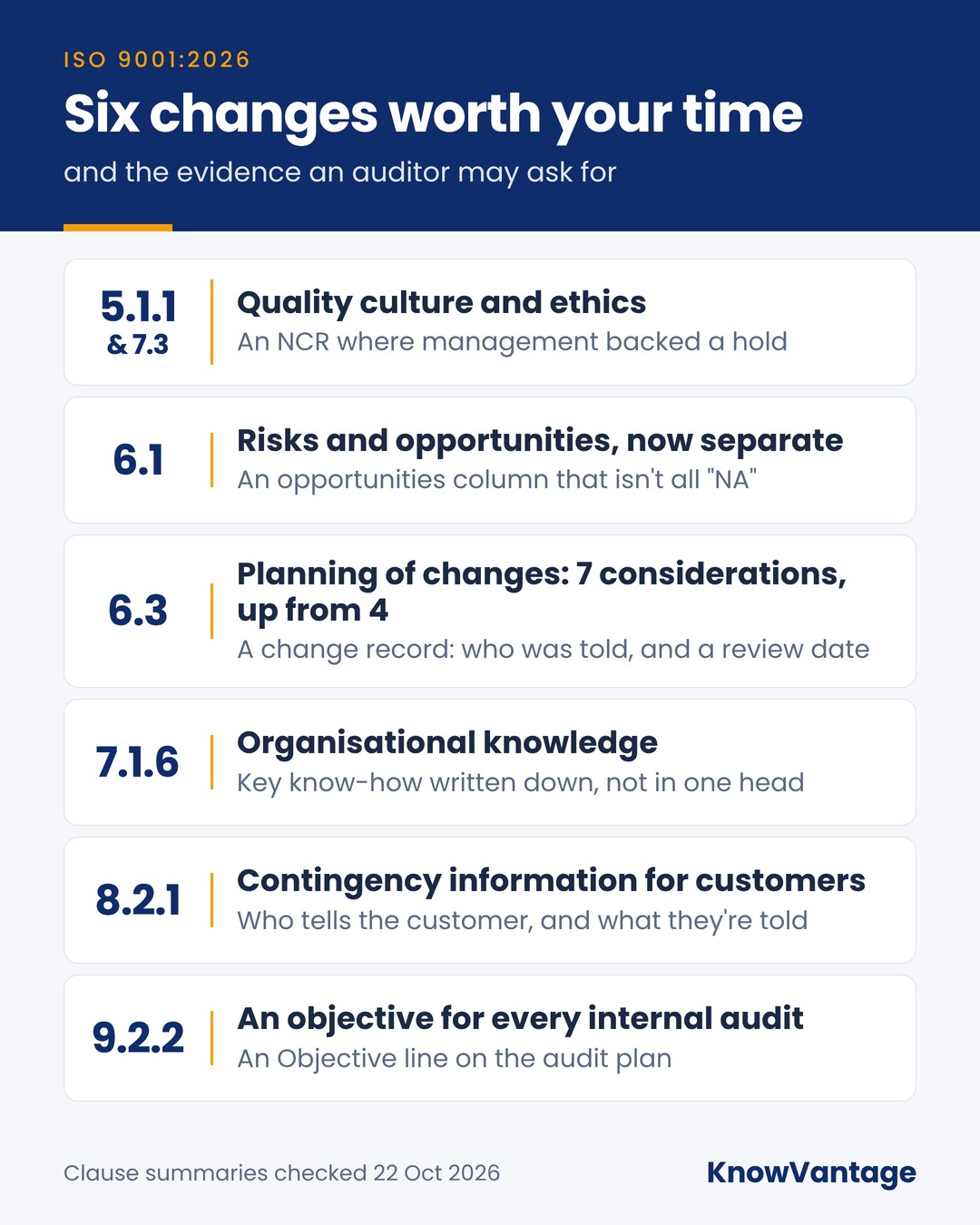
The new edition was published on 16 September 2026. Your 2015 certificate stays valid until 30 September 2029. The biggest change is that top management must now actively promote a culture of quality and ethical behaviour (clause 5.1.1). The other changes worth your time sit in 6.1, 6.3, 7.1.6, 8.2.1 and 9.2.2, with 10.1 in the table further down.
What hasn't changed in ISO 9001:2026
SGS confirms the Annex SL structure is kept. It's the same layout ISO 14001 and ISO 45001 use. PDCA and risk-based thinking stay at the centre, and most requirements carried over. Advisera lists clauses such as 8.5.6 control of changes and 8.7 control of nonconforming outputs as unchanged.
Climate change in 4.1 and 4.2 isn't new either. It arrived with the 2024 amendment to the 2015 edition, so if you addressed it then, nothing more is needed.
You don't need to rename documents or renumber your manual. The CQI advises implementers against restructuring where existing arrangements still work. If a consultant says the whole manual has to be rewritten, ask him which clause says so.
1. Quality culture and ethics: 5.1.1 and 7.3
Top management must now actively promote a culture of quality and ethical behaviour (5.1.1). Everyone working under your control must be aware of it (7.3), on top of the policy and objectives they already had to know. A note in 7.1.4 adds that culture and ethics can affect the work environment.
This is the change people will over-read. The standard gives no culture score, and the CQI's guidance asks auditors to keep it in proportion and not invent requirements. We wouldn't expect a finding over one lot pushed out under pressure. A pattern of holds overruled by the plant head is a different matter.
To find that pattern, an auditor might ask an operator what she does if she spots a defect at 6:40 on the last day of the month. Then the same question goes to the plant head. If the two answers don't match, that's the conversation you don't want in the closing meeting.
Few plants have been audited against the 2026 text yet, so nobody knows how strictly certification bodies will read 5.1.1. We'd keep two things ready anyway:
- one occasion on paper where management backed a hold over a dispatch, such as an NCR or an email
- awareness training records that mention culture and ethics, and not only the quality policy
2. Risks and opportunities, now separate: 6.1
In 2015 one sub-clause covered actions on both. The 2026 edition splits them. 6.1.1 covers determining risks and opportunities, and actions now have their own sub-clauses: 6.1.2 for risks, 6.1.3 for opportunities.
You now have to analyse and evaluate them. Actions were already meant to be proportionate. In 2015 the yardstick was product conformity, and now it's what the QMS is meant to achieve. A note points to risks to supply during and after a disruption.
Open your risk register. If the opportunities column says "NA" on most rows, that's the gap.
An opportunity isn't a risk written backwards. "A customer wants a second source in the south" is an opportunity. "Our only heat-treatment vendor is a single plant" is a risk. They need different actions, often with different owners.
For disruption, think about what actually stops plants in India: a transporter strike, or the monsoon week when the road to the industrial area floods.
3. Telling customers about contingencies: 8.2.1
Customer communication must now include relevant information about contingency actions, including disruptions to supply.
Most contingency plans we've seen cover DG sets and backup transporters and say nothing about the customer. Write down the name of whoever rings the customer and how many hours they have. Then check that person knows it's their job.
4. Planning changes to the QMS: 6.3
The list of things to consider when you change the QMS has grown from four items to seven. The three new items are monitoring whether the change worked, communicating it and reviewing the result. All three are about what happens after the change is approved.
Be clear on scope. Clause 6.3 covers changes to the system itself, like moving final inspection to in-process checks or bringing in a new ERP. Changes to production stay under 8.5.6, which Advisera lists as unchanged.
In our experience these changes rarely go wrong at approval. They go wrong three weeks later, when it turns out the night shift was never told. Add two lines to your change note: which shifts were told, and the date you'll go back to check the change held.
5. Organisational knowledge: 7.1.6
Organisational knowledge used to be tied to running processes and getting conforming product. In 2026 it has to support the intended results of the whole QMS. It must also be retained, applied and shared as far as needed, which is more than making it available.
Every plant has one setter who knows why machine 4 needs that extra shim. When he retires, the knowledge goes with him unless someone has turned it into a one-point lesson or paired him with a junior for a few months. Expect an auditor to ask who that person is in your plant.
6. Every internal audit needs an objective: 9.2.2
Scope and criteria were already required. Now each audit also needs defined objectives.
"Check that the new change-control process is followed on night shift" is an objective. "Audit production" isn't. Adding an Objective line to your audit plan template is a ten-minute job, and it's the first thing we'd expect an external auditor to look for on your plan.
Smaller changes worth a look
| Clause | What changed |
|---|---|
| 4.2 | Decide which requirements of interested parties you'll address through the QMS. Legal requirements and customer commitments can't be dropped. |
| 5.3 | Responsibility for keeping the QMS intact applies generally, including while changes are made. |
| 8.4.3 | Where relevant, tell external providers about requirements for their dealings with your customers and other interested parties. |
| 9.1.2 | Simply "monitor customer satisfaction". Complaints and social media are given as sources. |
| 9.3.2 | Management review now covers changes in interested parties' needs. The effectiveness of actions on risks and on opportunities comes in as separate inputs. |
| 10.1 | Continual improvement takes in the old 10.3, with monitoring and measurement results named as inputs. Advisera rates this a major change. |
| Annex A | Much expanded guidance on intent and terms. It adds no requirements. Annex B has been removed. |
When should you transition to ISO 9001:2026?
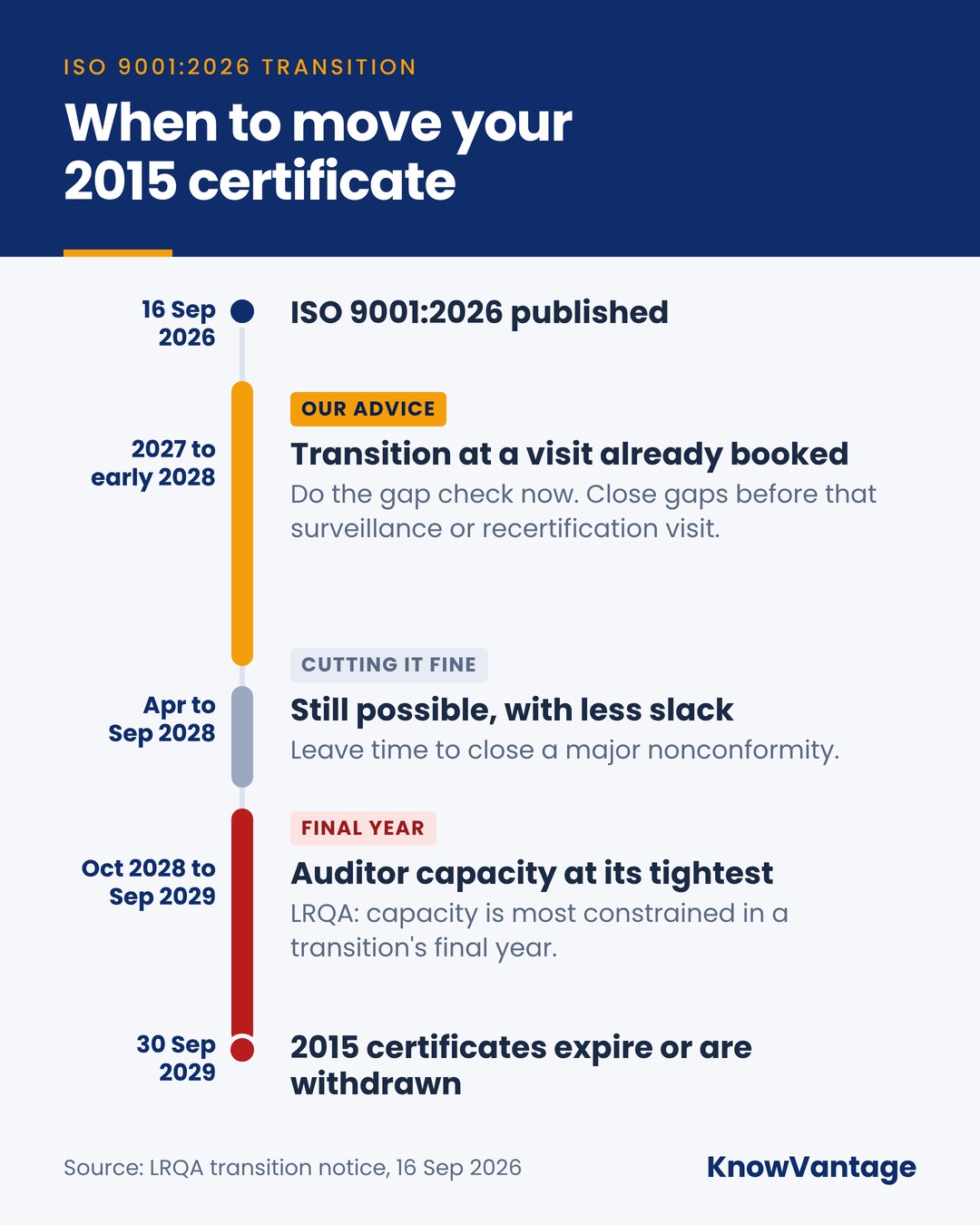
At a surveillance or recertification visit in 2027 or early 2028, not in the final year. The window closes on 30 September 2029, and LRQA, a certification body, is already scheduling transition audits.
LRQA also says audits get hardest to book in the last year of a transition. So we wouldn't leave it to the last twelve months. Do your gap check this year and close the gaps before that visit.
If you also hold ISO 14001, its 2026 edition is out too. That window ends in April 2029.
If you audit for a living
Most requirements carried over, so your 2015 checklist isn't scrap. It is out of date on 5.1.1, 6.1, 6.3, 7.1.6, 7.3, 8.2.1, 9.2.2 and every row in the table above, so update it before your next audit cycle. IRCA-certificated auditors have their own transition requirement to meet.
If you'd like the clause table above as a one-page PDF for your next management review, WhatsApp “ISO 2026” to +91 92178 08705. For team training on the 2026 edition, talk to us.
Questions people ask
When was ISO 9001:2026 published?
On 16 September 2026. It's the sixth edition of ISO 9001.
Is my ISO 9001:2015 certificate still valid?
Yes. It stays valid through the transition, which ends on 30 September 2029, but not after.
Do I have to rewrite my QMS documents for ISO 9001:2026?
No. Keep your numbering and document names, and change only what the new clauses show is missing.
Is climate change a new requirement in ISO 9001:2026?
No. It was added to the 2015 edition by the 2024 amendment and carried into 2026.
Can an auditor raise a finding on quality culture?
Yes, if the evidence for 5.1.1 or 7.3 is missing. The CQI's guidance tells auditors not to go beyond what those clauses say.


Reply to Comment